Whispers of the Wild: Decoding the Alarm Calls of the Indian Jungle
On an Indian safari, your eyes aren’t the only way to discover wildlife. Sometimes, the first clue that a predator may be nearby comes as a sound a sudden bark from a deer, a call from the treetops, or an unexpected change in the forest’s usual rhythm.
For experienced safari guides and naturalists, these sounds can provide valuable clues about what is happening around them. For travellers, learning to recognise a few common animal alarm calls can transform a game drive from simply looking for wildlife into learning how to read the forest.
Because in the Indian jungle, sometimes you hear wildlife before you see it.
The Jungle Is Never Really Silent
An alarm call is a sophisticated vocal signal triggered when an animal detects a potential threat. In the high stakes environment of the Indian wilderness, species like chital, sambar, and langurs serve as the forest’s early warning system. The primary biological purpose is survival: by emitting a specific sound, an individual warns its kin and other nearby species that danger is afoot, reducing the predator’s element of surprise. This shared communication network creates a “landscape of fear” that keeps the entire ecosystem on high alert.
Decoding the Chorus: Key Players in the Jungle Network
Understanding the specific “voices” of the jungle is essential for any wildlife enthusiast. Each species has a distinct acoustic signature and strategy for signaling danger.
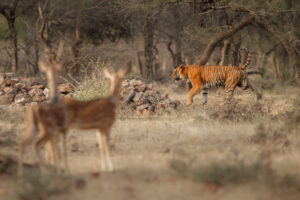
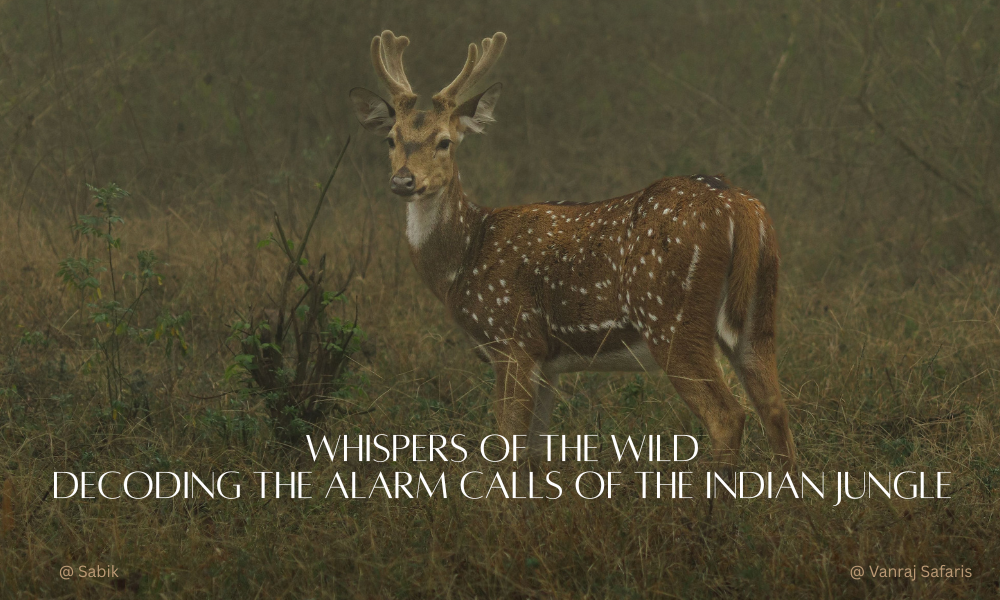
- The Chital (Spotted Deer): Perhaps the most common sentinel, the chital emits a sharp, high-pitched bark. When a herd is alerted, they often stand perfectly still, ears pricked, before erupting into a series of repeated calls that signal a predator’s movement through the undergrowth.These sounds can become particularly fascinating when exploring tiger habitats such as Tadoba National Park, where understanding animal behaviour can add another dimension to a safari.
- The Sambar: As India’s largest deer, the sambar possesses a much deeper, more resonant tonal bark. Because of their size and relative boldness, a sambar’s alarm call is often taken very seriously by guides; it frequently indicates a large predator like a tiger or leopard is in the immediate vicinity.
- The Barking Deer (Muntjac): Small and often elusive, the muntjac earns its name from its dog-like vocalization. Its dull, repetitive barking can persist for long periods, often triggered by the presence of a leopard or even a small carnivore moving through the dense thickets it calls home.
- The Langur: These arboreal sentinels provide a “bird’s-eye view” of the forest floor. From their high perches, langurs emit a loud, guttural coughing sound. Their calls are particularly useful because they can track a predator’s path from above, moving through the canopy as the threat progresses below.
- Peafowl and Jungle Birds: Birds like the Indian Peafowl add another layer to the system. A peacock’s loud, clarion call or the frantic cackling of a red junglefowl can be the first sign that something has disturbed the peace of the forest floor.

Chital vs Sambar vs Barking Deer: How to Tell Them Apart
If you’re new to Indian wildlife, these three deer can be easy to confuse. Here’s a quick reference to keep in mind before your safari.
Feature | Chital (Spotted Deer) | Sambar | Barking Deer (Indian Muntjac) |
|---|---|---|---|
Size | Medium-sized | Largest of the three | Smallest of the three |
Appearance | Reddish/golden-brown coat with distinctive white spots | Large, heavy body with a dark, coarse/shaggy coat | Small, compact body with a reddish-brown coat |
Antlers | Males have branched antlers | Males have large, prominent antlers | Males have small, short antlers |
Usually seen | Often in herds | Usually alone or in small groups | Often alone or in pairs |
Alarm call | Sharp, repeated alarm bark | Deep, loud/tonal bark | Distinctive bark-like call |
Easy way to remember | Spots + sharp bark | Big + dark + deep bark | Small + reddish + bark-like call |
What to watch for | Where the herd is looking | Its posture and direction of attention | Its sudden alertness and barking |
A simple way to remember them:
Chital = spots.
Sambar = size.
Barking deer = small and reddish.
And when it comes to their calls:
Chital = sharp bark.
Sambar = deeper bark.
Barking deer = bark-like call.
Expert Interpretation: Context is Everything
An experienced naturalist doesn’t just hear a sound; they interpret a scene. This is particularly important in parks with multiple safari zones. If Tadoba is on your itinerary, our Tadoba Safari Zones Guide explains how the park’s zones and gates work when planning your safari. The most critical lesson for any safari-goer is that an alarm call is not a guaranteed “tiger sighting.” Animals may alarm at a leopard, a sloth bear, a snake, or even a sudden human disturbance. To truly understand the message, one must observe the caller’s body language. Is the animal staring intensely in one direction? Is it standing with rigid posture, or is it calling casually while continuing to graze? Experts look for the “chorus effect” when multiple species, such as a langur in the trees and a chital on the ground, are both alarming in the same direction, the probability of a major predator increases significantly. Experiences like this are part of what makes India’s central forests such as Kanha so fascinating for wildlife travellers. Our Kanha Safari Guide covers the park and what to expect when planning a visit. Managing expectations and remaining quiet during these moments allows the forest to reveal its story at its own pace.
 Beyond the Basics: Predator vs. Prey Dynamics
The nature of an alarm call often changes based on the type of threat detected. Ground predators, such as tigers or leopards, typically elicit persistent, repetitive calls as the prey attempts to keep track of the predator’s location. In contrast, aerial threats like a Crested Serpent Eagle might trigger a short, explosive burst of sound that causes the herd to scatter immediately into the thicket. Some species even have “referential” calls, where the sound itself carries information about whether the threat is on the ground or in the air, allowing others to choose the most effective escape route.
Conclusion: Becoming a Part of the Forest
The next time you find yourself in the heart of the Indian jungle, remember that the most exciting sightings often begin with a sound. By shifting your focus from just “looking” to truly “listening,” you align yourself with the rhythm of the wilderness. Respect the silence, trust your naturalist, and pay attention to the whispers of the wild. The jungle is always speaking; you just need to know how to hear it.